
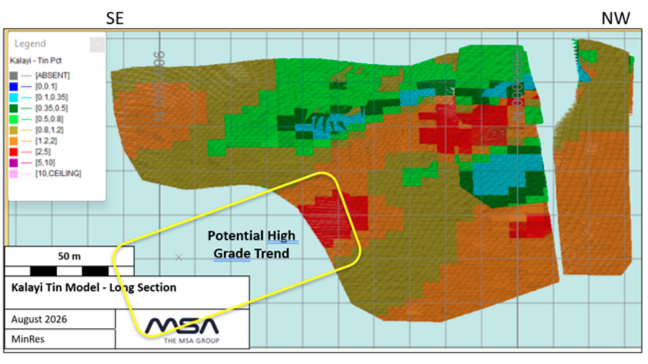

Rome Resources (RMR) has identified two new mineralised zones at its Kalayi tin deposit in the Democratic Republic of the Congo (DRC), alongside a significant undrilled continuation of the high-grade tin trend to the southeast of existing drilling.
The MINZ8 and MINZ9 zones were identified as part of ongoing work on the Kalayi Mineral Resource Estimate (MRE). The zones are currently supported by a single drill intersection and require further drilling to establish continuity.
The latest modelling also identified a substantial undrilled extension of the high-grade tin trend southeast of existing drilling.
However, MINZ8 and MINZ9 will not be included in the forthcoming MRE as further drilling is required.
The updated Kalayi MRE is being finalised will be announced separately. Meanwhile, airborne geophysical interpretation is underway across the wider Bisie North Project to identify further exploration targets.
Rome also reported encouraging initial grab sample results from its optioned New Brunswick tin-tungsten-indium project in Canada, with follow-up trenching underway and detailed assay results to follow.
Rome Resources Chief Executive Officer Paul Barrett said: "The identification of MINZ8 and MINZ9, alongside identification of a significant undrilled continuation of the high-grade trend to the southeast, gives us clear targets for the next phase of drilling and further resource growth at Kalayi.
The updated MRE remains an important near-term milestone and these new targets demonstrates the significant potential beyond the areas sufficiently drilled for inclusion in the current MRE.
In parallel, initial results from New Brunswick are encouraging and follow-up trenching is now underway as we build this second potential critical minerals opportunity in Canada."
View from Vox
The latest modelling adds further exploration upside at Kalayi ahead of the updated MRE. The new zones and undrilled southeast extension provide clear targets for future drilling, while the Canadian results offer an additional source of potential growth.