

By Kathleen Brooks, research director at XTB
The market remains in a bullish mood as we wait for further details on whether a deal will be agreed between the US and Iran to end the war and progress is made to reopen the Strait of Hormuz. The news that a deal was in place was a catalyst for another leg higher for global stocks, the Nikkei rallied more than 5% overnight, and US stock indices hit record highs. Markets are still hoping for the best on the Middle East, but European stocks are trading with a more cautious tone on Thursday, even if there is a bullish backdrop.
Oil price decline continues
The FTSE 100 is slipping as the oil price declines. The price of Brent crude is trading between $98 and $102 per barrel on Thursday, the dollar remains weak, after a sharp sell off on Wednesday. The yen is the strongest currency in the G10 this week and is higher by more than 2%. In contrast, the dollar is the weakest currency in the G10, as a mixture of official intervention in the FX market and hopes that the war will end quickly, combine to add downward pressure to the buck. News suggests that Japanese officials used $30bn of FX reserves to boost the yen this week, this suggests two things: 1, they may not be able to do this indefinitely, and 2, Japanese officials mean business when it comes to propping up the yen. FX volatility could be here to stay.
UK bonds are calm, for now…
The pound is a laggard on Thursday, however, GBP/USD is higher by 0.66% so far this week, even as political risks rise. UK local elections take place today, the outcome should be known by tomorrow. There is a risk that the Prime Minister could see a significant challenge to his position from within his party if Labour do as badly as expected in these elections. UK Gilt yields are falling for a second day, as the oil price declines. The 10-year yield is comfortably below 5% on Thursday, at 4.92%, however, UK yields remain significantly higher than other major countries, and the bias for yields will be to the upside if Kier Starmer is forced out of office in the coming days, or if Rachel Reeves suggests an even further lurch to the left in this year’s budget.
UK earnings season vs. US earrings season, a clear winner
The outlook for stocks remains divided by region. There is a clear split between the performance of US corporates this earnings season and elsewhere, especially Europe. There were some large misses for the likes of HSBC , where net profit rose by just 0.1% after last quarter’s performance was hit by a fraud-related exposure of $400mn, and the impact of the Middle East war. This should be a one-off charge, and even though net interest income for the bank rose, the stock price is flat on the week. Shell also reported earnings this morning, it reported a 37% increase in profits and beat expectations for revenue. However, a reduction in its share buyback programme along with a sharp decline in the energy sector due to the fall in the oil price this week, means that Shell and BP are weighing on the FTSE 100, and are both down 5.7% and 7% respectively. This is one reason why the FTSE 100 is bucking the overall upbeat tone for global stocks on Thursday.
This compares with some standout earnings reports in the US this week, including AMD, which rose by 18% after its results were released on Tuesday night, Uber and Walt Disney also rose sharply on Wednesday, after reporting more robust consumer demand for their services. Corporate earnings growth for the FTSE 100 and other European markets cannot compete with US indices, largely because of the tech sector, but also because economic data remains stronger in the US compared to elsewhere.
It’s not all bad news for the UK
However, while the US is the star of the show this corporate earnings season, UK earnings are growth expectations have been revised higher, for example, UBS has upgraded its growth forecast for UK earnings this year to 11%, and expects earnings growth of 10% next year, even though there is an energy price spike. Likewise, there have been a raft of UK sectors that are posting strong results for Q1, including pharma, energy, and some banks. This should sustain interest in the FTSE 100 in the medium term, even if the index is lagging its global peers on Thursday. For the UK to get back to its winning ways, a pickup in the gold price and a continuation of the recent demand for defense names will be needed to drive the index higher.
Looking ahead, all eyes will be on news coming out of the Middle East, there could also be a focus on Friday’s payrolls. A stronger than expected ADP report means that the market could be expecting an upside surprise for NFPs on Friday. Currently, expectations are for a reading of 60k last month.
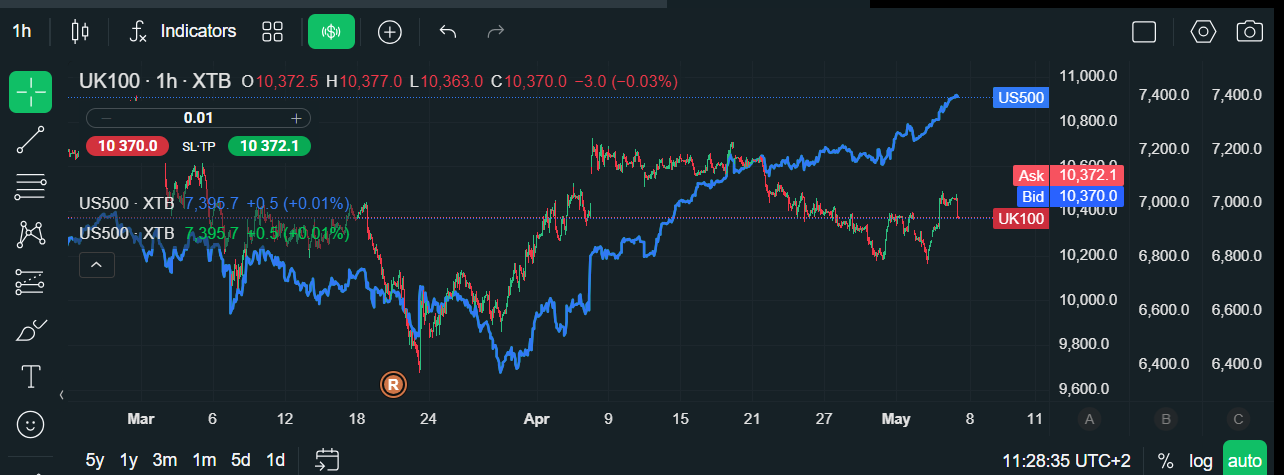
Chart: FTSE 100 and S&P 500, there has been clear underperformance of the UK index vs. the US index in the last 3 months.
Source: XTB
XTB CY-RISK DECLARATION: CFDs are complex instruments and come with a high risk of losing money rapidly due to leverage. 72% of retail investor accounts lose money when trading CFDs with this provider. You should consider whether you understand how CFDs work and whether you can afford to take the high risk of losing your money.
XTB UK-RISK DECLARATION: CFDs are complex instruments and come with a high risk of losing money rapidly due to leverage. 70% of retail investor accounts lose money when trading CFDs with XTB Limited UK. You should consider whether you understand how CFDs work and whether you can afford to take the high risk of losing your money.
XTB is a trademark of XTB Group. XTB Group includes but is not limited to following entities:
X-Trade Brokers DM SA is authorised and regulated by the Komisja Nadzoru Finansowego (KNF) in Poland
XTB Limited (UK) is authorised and regulated by the Financial Conduct Authority in United Kingdom (License No. FRN 522157)
XTB Limited (CY) is authorized and regulated by the Cyprus Securities and Exchange Commission in Cyprus. (License No.169/12)
Clients who opened an account from the 1st of January 2021 and are not residing in the UK, are clients of XTB Limited CY.