
By Kathleen Brooks, research director at XTB
· Mood shifts for markets as AI scare trade dominates
· Sell off spills over into Asian markets
· US software sector is trading at its cheapest level since 2022
· AI trade splits between winners and losers
· Europe is a harbour in the storm for now
· CPI risks loom
Markets are nervous as we end the week. Stocks sold off sharply during the US session on Thursday, the Nasdaq fell more than 2%. The main US indices are now posting YTD losses and the Nasdaq crossed some important technical barriers, including the 50-day and 100-day moving averages, which confirms that momentum is to the downside. Both the S&P 500 and the Nasdaq are underwater for the year so far, as the AI Scare trade continues to grip markets.
The sell off in US stocks is spilling over into global equities and the MSCI World Index is set to have its first back-to-back weeks of losses for 2026. Stocks in Asia followed the US lower on Friday, although European stock market futures are pointing to a slightly higher open for the Dax and the FTSE 100 today, as Europe catches a bid. We assume that sentiment will be fragile as we end the week, and futures markets are pointing to a continuation of the selloff in the US later today.
The AI scare trade is back
The AI scare trade continues to dominate markets, and as new AI tools are introduced, the ripple effects are widening. For example, silver and gold prices plunged on Thursday, as precious metals continue to move with stocks and broader risk sentiment. Gold and silver are both staging a recovery this morning, however they have not recouped the losses after Thursday’s plunge.
Bitcoin is also higher today, although it remains close to the lows of the week. Bitcoin is worth watching due to the link between crypto and AI stocks. Capital has poured into crypto and AI-linked stocks in recent months and years, and there has been some overlap, which is why they are moving together in 2026.
There could be a new stage in the stock market sell off as the AI disruption trade broadens out. For most of 2026, the narrative has been about the rotation out of US tech stocks and into value-linked sectors of the US market. However, that was not the case on Thursday, when the equal-weighted S&P 500 fell at the same time as the market-cap weighted S&P 500, which is heavily influenced by the tech sector.
AI trade splits between winners and losers
The worst performing stock on the US market was Applovin, which dropped nearly 20% yesterday. Dell and Cisco were also in the cross hairs of the sell off, as the S&P 500’s software sector falls to its cheapest valuation since 2022. The AI theme is unpredictable and leading to a sea change in market sentiment. For example, the top performers on Thursday included Sandisk the memory chip maker, and Equinix, which runs a worldwide network of data centres. AI is coming, and there is demand for companies linked to the development of AI, however, the effects of the new technology are having a hugely disruptive effect on markets as we move through February.
Europe is a harbour in the storm
Interestingly, Europe’s lack of tech exposure is lending it some immunity to the recent sell off in the US. For example, the FTSE 100 is up 4% YTD, while the Nasdaq is lower by 2.7%. However, if the move away from tech leads to a broader de-risking, then European outperformance may not last long.
CPI risks loom
Elsewhere, the focus is on the dollar, as the FX market attracts haven flows. We also get the US CPI report later today. The market expects headline and core CPI to moderate to a 2.5% annual rate, however, in the current environment, signs that inflation pressures are building in the US and rate cuts may not be forthcoming could knock sentiment towards stocks and other risky assets even more.
Chart 1: The Nasdaq Composite Index
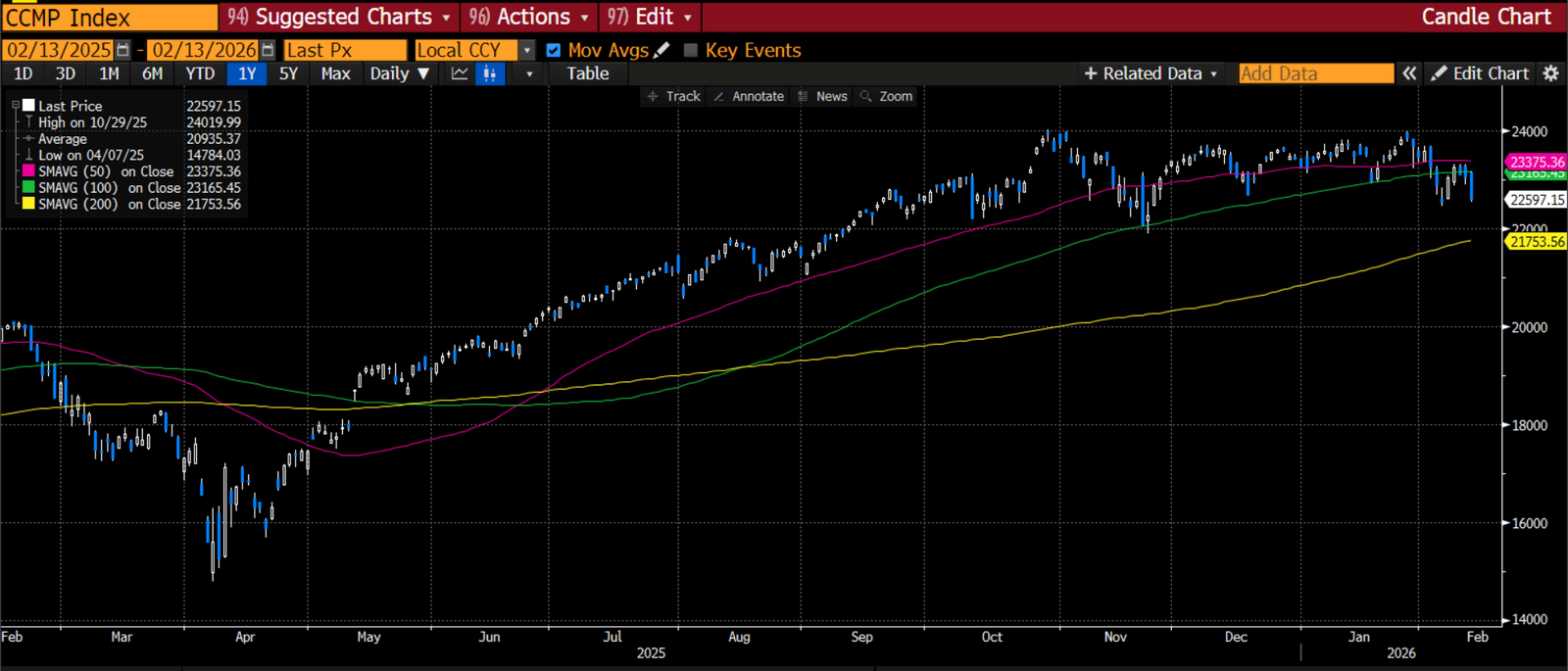
Source: XTB and Bloomberg

XTB CY-RISK DECLARATION: CFDs are complex instruments and come with a high risk of losing money rapidly due to leverage. 75% of retail investor accounts lose money when trading CFDs with this provider. You should consider whether you understand how CFDs work and whether you can afford to take the high risk of losing your money.
XTB UK-RISK DECLARATION: CFDs are complex instruments and come with a high risk of losing money rapidly due to leverage. 70% of retail investor accounts lose money when trading CFDs with XTB Limited UK. You should consider whether you understand how CFDs work and whether you can afford to take the high risk of losing your money.
XTB is a trademark of XTB Group. XTB Group includes but is not limited to following entities:
X-Trade Brokers DM SA is authorised and regulated by the Komisja Nadzoru Finansowego (KNF) in Poland
XTB Limited (UK) is authorised and regulated by the Financial Conduct Authority in United Kingdom (License No. FRN 522157)
XTB Limited (CY) is authorized and regulated by the Cyprus Securities and Exchange Commission in Cyprus. (License No.169/12)
Clients who opened an account from the 1st of January 2021 and are not residing in the UK, are clients of XTB Limited CY.