
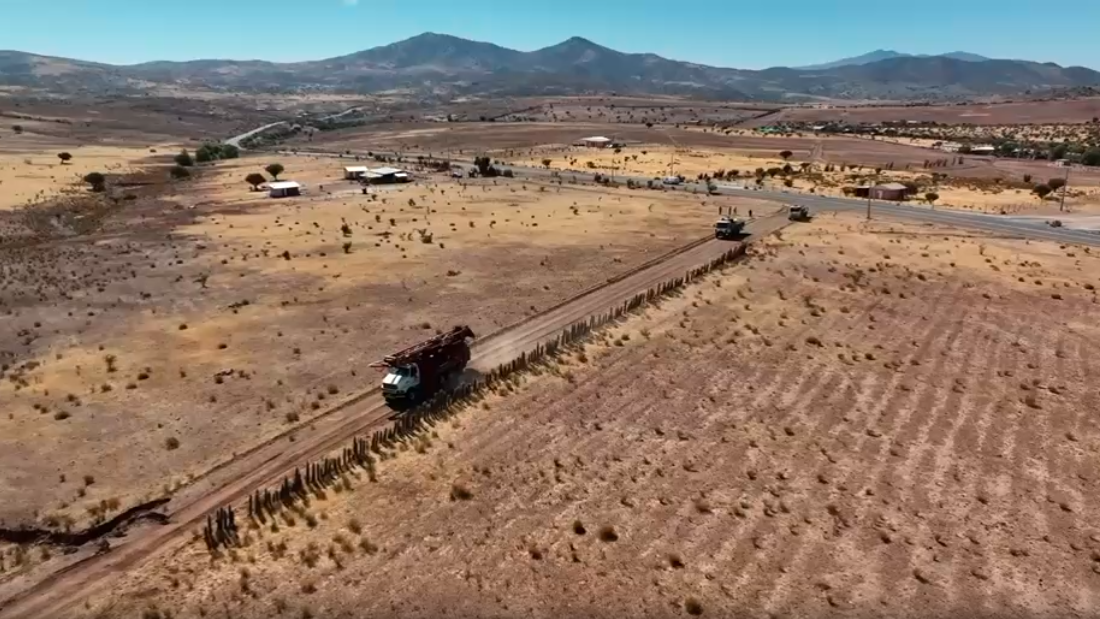

Great Southern Copper (GSCU ) has completed its first scout reverse circulation drilling programme at the Especularita project in Chile.
Seventeen scout RC holes were completed, for a total of 2,474 metres drilled.
The drilling is targeting large-scale porphyry copper systems, and focused on prospects along the western and southern margins of the La Colorada lithocap.
Lithocaps can lie over and conceal the location and source of potential porphyry copper mineralisation at depth. They are formed as hot acidic fluids ascend to the surface from a porphyry intrusion below and interact with the enclosing wall rocks. Interaction with porous volcanic rocks typically results in a laterally extensive, flat-lying "blanket" of silica-mica-clay-pyrite alteration.
Especularita is located at low elevation with excellent access to infrastructure and mining services and along trend of more than 85 million tonnes of contained copper hosted in major deposits including Los Pelambres, Altar and El Pachon.
Elsewhere, exploration is continuing on multiple fronts across the project to enable the momentum of drilling work to continue. In particular, mapping and sampling at both the Cerro Negro and Viuda prospects is ongoing and aimed to assist with planning for the next phases of exploration drilling in those locations.
In addition, final leach test results are pending from the Mostaza metallurgical test work conducted on Phase I and II high-grade drill core samples, and planning for extensions to the Cerro Negro induced polarisation survey is also underway. The survey is anticipated to commence within a few weeks.
Furthermore, detailed prospect-scale mapping and sampling are continuing at both the Viuda and Cerro Negro prospects. New results from this ongoing work, together with results of the planned geophysics surveys, will direct targeting for the next phase of drilling at both Viuda and Cerro Negro.
"We are pleased to have completed our first drilling test of the flanking margins of the giant lithocap alteration system at Especularita,” said Sam Garrett, chief executive of Great Southern Copper.
“This programme is important because it will allow us to vector future drilling within the lithocap to target areas that have the most potential to host copper and gold mineralisation. The lithocap covers a vast area of over 75 square kilometres, however, we suspect that it was originally much larger and has since been eroded - potentially exposing porphyry copper style alteration at the present surface. The RC drilling has proven highly effective in efficiently testing four prospect targets, and the results from this programme already suggest that we are seeing porphyry-related phyllic alteration at surface at Piedras Blancas and Artemisa North and, more importantly, potassic alteration at shallow depths below that.”
View from Vox
First assay results from the RC drilling at Especularita are expected within the next two-to-four weeks, so we won’t have long to wait to find out if Great Southern is on the right track. The potential rewards on offer are significant, as this really is big game hunting. But Chile is the right place to be for copper mining. Meanwhile, in the background the world’s need for copper just keeps on growing.