
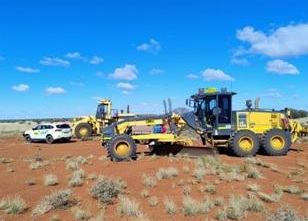

Georgina Energy (GEX) has confirmed that pre-drill site works at its wholly owned Hussar project in Western Australia are progressing as planned, keeping the company on track for a September 2026 spud date.
Preparatory activities at the EP513 licence include road and airstrip repairs, site access improvements, water well drilling, and construction of the drill pad and accommodation camp ahead of the mobilisation of contracted Ensign Rig 970. The work is required under the approved Well Management Plan and is being carried out in consultation with Traditional Owner representatives.
The Hussar prospect, located in the Officer Basin, covers about 300 square kilometres of areal closure and is considered one of Australia's largest onshore subsalt prospects for helium, hydrogen and hydrocarbons. Georgina plans to drill the well to a depth of 3,200 metres to test the Townsend Formation and fractured Neoproterozoic basement targets for helium, hydrogen and natural gas.
Independent assessments have estimated net attributable 2U prospective resources of 155 billion cubic feet of helium and 173 billion cubic feet of hydrogen, alongside 1.73 trillion cubic feet of natural gas.
"Georgina remains on target for the drilling and development of its wholly owned Hussar EP513 Project," said Georgina Energy Chief Executive Officer Anthony Hamilton.
"We are pleased with the progress of current site works to ensure the Ensign Drill Rig will be mobilised and the current planning and civil engineering works will be successfully completed in order to enable the drill testing of this exciting prospect in Q3 2026. With 300 square kilometres of areal closure, the Hussar prospect is one of the largest subsalt helium, hydrogen and hydrocarbons prospects onshore in Australia."
View from Vox
Georgina Energy continues to execute its operational timetable ahead of what is expected to be a pivotal drilling campaign later this year. With site preparation advancing on schedule and rig mobilisation approaching, investor attention is likely to shift towards the September spud and the potential to unlock one of Australia's largest onshore subsalt helium and hydrogen exploration targets.