
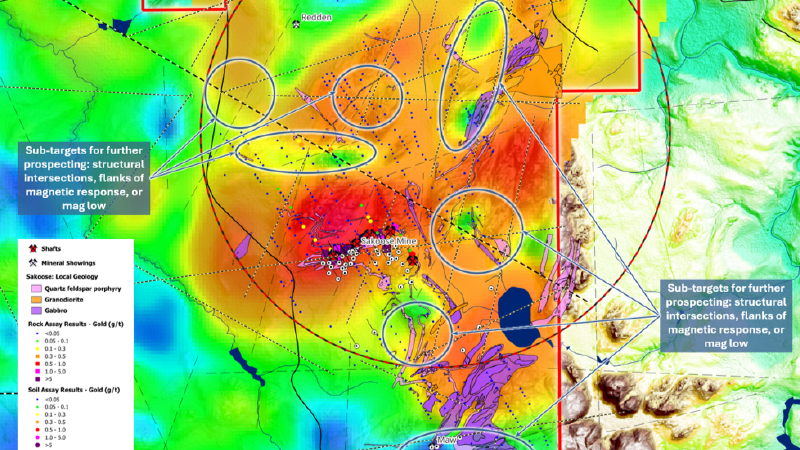

Rchmond Hill Resources (RHR ) has completed its field reconnaissance and rock sampling programme across the Martello gold project in Ontario.
The programme was undertaken to ground-truth the priority exploration targets identified by the recently completed independent 3D magnetic interpretation, while collecting geological and structural information to refine future drill targeting.
Fieldwork focused on three target areas: Sakoose, Maw and Church Lake.
Thirty-five rock chip samples were collected, and quartz veins and veinlets mapped across the three prospects.
Evidence has been identified at Sakoose that shows multiple quartz vein systems may be present.
Sulphide mineralisation was also observed at each target area, with hydrothermal alteration noted at Sakoose and Church Lake.
The samples taken have now been submitted for gold and multi-element analysis, with results expected during the current quarter.
At Sakoose, historical mine workings, drill pad locations and quartz vein exposures were examined.
Field observations confirmed that the historically mined quartz vein locally varies from approximately 15 centimetres to two metres in thickness. Additional quartz veinlets were identified together with widespread hydrothermal alteration within both the quartz-feldspar porphyry and surrounding metabasalt. These observations provide evidence that multiple vein systems may be present and will be evaluated further, following receipt of assay results.
At Maw, reconnaissance identified numerous quartz veins and veinlets hosted within gabbro and quartz-feldspar porphyry dykes. Several distinct structural orientations were recorded, indicating the presence of multiple vein sets. The field team also identified a historical excavation believed to represent the principal historical working, and collected a sample from the associated stockpile. These observations will be integrated with the forthcoming assay results to prioritise future exploration.
At Church Lake, fieldwork identified additional quartz vein occurrences, historical workings and multiple structural trends. Although vegetation limited bedrock exposure in parts of the target area, several prospective zones were mapped and sampled, where accessible, during the programme. The work also confirmed structural orientations comparable to those recognised elsewhere across the Martello project.
"This programme represents the first systematic field assessment of our high priority targets following the independent 3D magnetic interpretation,” said Hamish Harris, executive chairman of Richmond.
“The work has provided valuable new geological information from Sakoose, Maw and Church Lake and has strengthened our understanding of these priority targets. We are particularly encouraged by the observations at Sakoose, where the field team identified evidence that multiple vein systems may be present. Together with the pending assay results, this work will help refine our geological model and support the next phase of drill targeting across the project."
View from Vox
This work represents steady and systematic progress towards defining drill targets on three of the most attractive areas of Martello. The geological understanding has been considerably enhanced, although we will have to wait for the assays to be returned before the full, updated picture emerges. But it’s good to see these targets taking shape, and looking ever more ready to receive the attentions of a drillbit.