
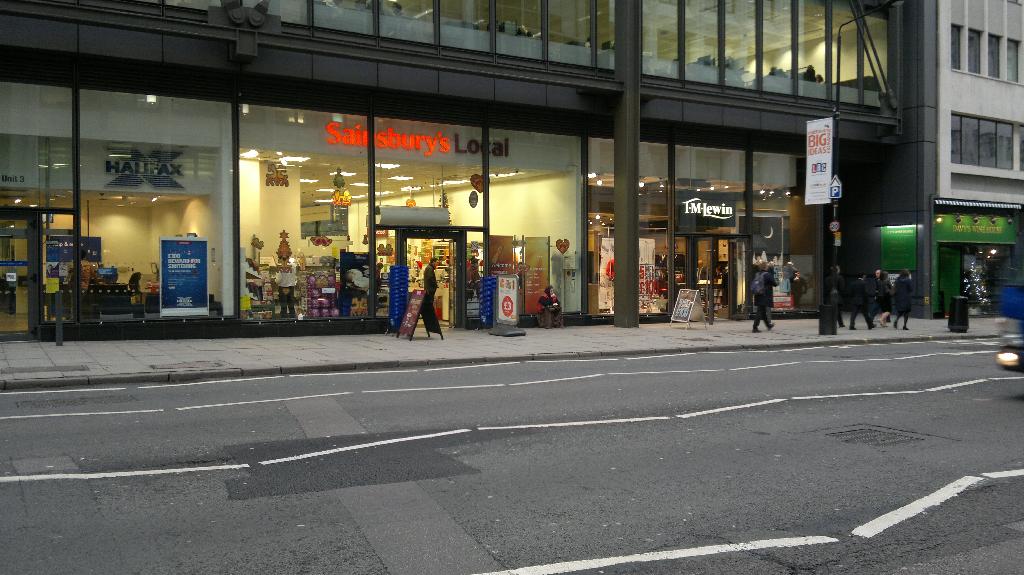
Sainsbury’s suffers as price war dominates Christmas trading. Sainsbury (J) (SBRY) on Wednesday emerged as one of retail’s Christmas losers as it posted lacklustre festive trading, and left hopes hanging on a £14 billion merger with rival Asda. Sales of clothing and items such as electricals and furniture proved the sore point as the group saw sales drop for the third quarter to January 5. Sainsbury’s same-store sales, excluding fuel, fell 1.1%, and were dragged down by selling fewer non-food items. Grocery sales were up 0.4%, below City hopes and lagging Morrisons, which yesterday said its retail sales were up 0.6% over Christmas. Lidl, Aldi and Asda appear the early festive winners, with Tesco and Marks & Spencer due to update the City tomorrow. Its general merchandise arm, which includes the Argos chain, was hurt by “cautious customer spending” as well as its decision not to discount as much as rivals over Black Friday. General merchandise was down 2.3%. “While there’s little Christmas cheer in these numbers, Sainsbury’s investors could yet get a delayed present if the [competition authority] approves its proposed tie-up with Asda,” said Hargreaves Lansdown’s George Salmon. He added: “It won’t have gone unnoticed that Asda looks to have had a pretty good Christmas.”
Productivity slumps to two-year low. Britain’s productivity problems show little sign of ending after output per hour slumped to its weakest level in two years. For the three months to September, productivity was only 0.2% better than the same period last year, the Office for National Statistics said. It was the worst annualised rate of growth since the third quarter of 2016. Productivity growth is a key indicator of a nation’s prospects and future living standards. Without it, companies struggle to produce more with the same resource and, as a result, are unable to increase wages faster than prices. Weak productivity hits everyone as living standards stagnate and businesses lose their edge against overseas rivals. Lower real pay and fewer corporate profits mean that less tax is collected. Britain has seen barely any productivity growth since the end of 2007, after enjoying annual growth of around 2% in the preceding decade. The “productivity puzzle” has not been unique to the UK but has been more pronounced, although questions remain about the consistency of measurement across countries.
Ted Baker thrives despite ‘Hug-gate’ probe into boss Ray Kelvin. Shoppers continued to swarm to Ted Baker (TED) over Christmas despite harassment allegations against its boss and founder Ray Kelvin, it emerged on Wednesday. Finance director Lindsay Page, who has stepped up to acting chief executive after Kelvin took leave of absence in early December, said recent events had galvanised staff. “There has been a determination to show the world how good we are. Staff are very motivated. It’s business as usual,” Page added. The fashion brand saw retail sales rise 12.2% for the five weeks to January 5, allaying fears that shoppers would shun the brand in protest. “We did well on outwear and knitwear,” said Page. Shares, which had been hit over the past month as allegations of inappropriate behaviour towards staff emerged, rose 183p, or 11.3%, to 1799p. “Not even the allegations seem to have diminished desire for the Ted Baker brand,” said Emily Salter, a retail analyst at GlobalData.
Sosandar (SOS) has shot lower despite posting a whopping 219% rise in revenues for the three months ended December 2018. As a result the company expects revenue for the full year to be ahead of expectations and the net loss for the year to be in line. Traders saying that shares are down on the fact that Sosandar is still heading for a full year loss. Yet analysts in the City believe it will be a winner. Greg Lawless at Shore Capital: “Sosandar is one of the Christmas winners in 2018 alongside Dunelm, Joules and Selfridges, thus far, in the 2018 festive reporting season. “Like many retail stocks, Sosandar’s share price has been weak of late (down 21% in the last month alone), as Brexit concerns continue to weigh on consumer sentiment. “The recent fund-raise back in October 2018 strengthened the balance sheet, with net cash of £4.6 million at the end of December 2018. We continue to highlight a fair value of c.50p, representing significant potential share price upside.”
Science In Sport (SIS) the sports nutritionist posted a decent increase in sales for the year. SiS, which counts Olympic gold medal swimmer Adam Peaty and cyclist Mark Cavendish among its users, added that it was upbeat on the potential of its £32 million acquisition of PhD Nutrition which it bought in November
Shoe Zone (SHOE) has declared a special dividend on the back of record profits. The retailer, which specialises in cheap footwear, said pre-tax profits rose 18% to £11.3 million, boosted by its “big box” stores on retail parks. It was the highest annual profit increase since floating in 2014. Paul Hickman analyst at Edison Investment Research said: “Nobody told Shoe Zone that there’s a retail crisis. “The company has delighted investors since its IPO five years ago with an 18% rise in pre-tax profit to £11.3 million and 20% growth in earnings per share to 19.0p, an 8% beat against the market forecast. “It opened 10 of its targeted Big Box superstores and now has 25 with 20 more planned in 2019. “Value is the key to the success of its product offer. It sources its products directly with Chinese manufacturers, and though up 4.7%, the average transaction value is only £12.98.
Majestic Wine (WINE) is in urgent need of an overhaul, admits chief executive Rowan Gormley, while his online brand Naked is booming. Gormley says it is “highly unlikely that we’d bin a brand with 30 years of heritage” but says a “significant change” to its operations is required. He’ll tell the market what that plan might be at full-year results in June, but wouldn’t be drawn today on whether it would mean a move up or down market for Majestic. In the 10 weeks to December, group sales rose 6.3%. Naked was the star performer, up 15.9%. It surpassed Majestic as a source of profits for the group last year. Wine lovers were as cautious as anyone else over Christmas, with “economic uncertainty and weak consumer confidence” weighing on sales. Still, profits for the year should hit City forecasts of between £11 million and £13 million. The shares have been in a slump since at least November, when they were around 410p. Today they were flat at 260p, which leaves the company valued at £180 million
Surrey council buys £140m City office block. A Surrey council is buying a prime City office building as it continues an unlikely £1 billion buying spree of commercial property around the UK. Spelthorne Council is close to finalising a deal to buy 100 Cheapside in the City of London for about £140 million in what would be its first entry into one of the most competitive property markets in the world. The 100,000 sq ft office building is the London headquarters of Goodwin Proctor, the law firm, and Ashtead, the construction group. It is being sold by Standard Life Aberdeen in a sale process managed by HFF, the property advisory firm. Local authorities spent £1.8 billion last year buying shops, shopping centres and offices in an attempt to establish a secure income stream to replace cuts to government funding. The majority of purchases are funded by loans from the Public Works Loans Board, part of the Treasury, which allows councils to borrow at low interest. There are no limits to how much they can borrow and they do not have to prove they can afford it.
Hargreaves Lansdown in bust-up with star stockpicker Terry Smith. A row has erupted between Terry Smith, one of the outstanding stockpickers of recent years, and Britain’s biggest funds platform after it excluded him from its new list of 50 top fund managers that it recommends to clients. Mr Smith, a City big-hitter who founded his own firm Fundsmith ten years ago, accused Hargreaves Lansdown (HL.) of making recommendations based on their potential to maximise its own profits rather than because they performed well for investors. The allegation came hours after Hargreaves had unveiled a new list of 50 recommendations, omitting Mr Smith, whose Fundsmith Equity fund has produced a 270% return in nine years, while including Neil Woodford, the embattled star fund manager struggling with underperformance for three years.
Faroe Petroleum gives in to Norwegian takeover. North Sea oil company Faroe Petroleum (FPM) has surrendered in the takeover battle against its largest shareholder, the Norwegian oil giant DNO. The Aberdeen-based company capitulated to the hostile power grab after a steady campaign by DNO to wrest control of Faroe for a price well below its valuation. The board said it did not believe DNO’s offer to pay shareholders 160p a share to turn their back on the company represented “fair value”. It has nonetheless urged shareholders to take up the offer after DNO tightened its grip on the company to approximately 52.44% after raising its offer price from 152p a share on Tuesday evening.
Greggs’ vegan sausage roll proves biggest hit in six years. Greggs (GRG) has sold “hundreds of thousands” of its new £1 vegan sausage rolls in the first week of January, making it the fastest selling new line in six years. The bakery chain said the new savoury snack, which launched earlier this month in 900 of its stores with the biggest vegetarian food sales, sold out instantly. “It has taken us by surprise,” said Roger Whiteside, chief executive. “We didn’t know if it would sell or not but it has been flying off the shelves.” Mr Whiteside added that sales of its normal sausage rolls were boosted by the new product, as customers who failed to lay their hands on the vegan roll settled for the original as an alternative.
Vimto supply safe after Brexit, says Nichols as sales sparkle. Britain will not run out of Vimto under any Brexit scenario because key ingredients are sourced at home, executives at owner Nichols (NICL)have insisted. “All of our products are produced here in the UK, so we don’t rely on imports into the UK,” said Nichols finance chief Tim Croston. The comments came amid burgeoning British demand for Vimto and other Nichols drinks. UK sales rose 12.6% to £115m in the year to Dec 31, figures the company called “an excellent performance”. Investors agreed, sending shares in the company up 6.5% in lunchtime trade.
Topps Tiles eyes trade customers as shoppers cool on DIY. Topps Tiles (TPT) has hailed progress in its commercial arm as it looks to sell more products to businesses and trade customers to make up for retail shoppers turning their backs on DIY. The retailer said that it expects its Parkside division to become profitable by 2020 after it lost £1.1m in the year to Sept 29. Parkside, which it bought in 2017, supplies businesses such as restaurants and hair salons with tiles. It expanded its sales team during the last year and plans to open two new showrooms in the second quarter. Matthew Williams, chief executive, said: “Traditionally we are in the retail market but we are excited by the opportunity of the commercial division.
Taylor Wimpey shakes off caution with ‘robust’ trading. Taylor Wimpey (TW.) reassured investors concerned about a possible slowdown in the market for new homes, confirming it was on track to meet forecasts for 2018 and predicting a “stable” performance this year. The FTSE 100 housebuilder built about 15,000 homes last year, some 3% more than 2017, and said trading had remained “robust” despite caution among some buyers in London and the south east towards the end of the year. Its average selling price in 2018 rose 2% to £301,000 and it ended the year with an order book worth £1.8bn, up from £1.6bn the previous year.
Majestic Wine refuses to rule out store closures. The boss of Majestic Wine (WINE) has refused to rule out store closures as Christmas revenue growth doubled, driven by surging online sales. Comparable revenue for the 10 weeks to the end of December grew by 6.8% as chief executive Rowan Gormley insisted Majestic had “what it takes to be one of the winners” amid a “revolution in retail”. Like-for-like sales from online arm Naked Wines performed best, rising 15.9% on an underlying basis. “Most people’s perception of the Majestic Group is that it is a big offline retailer with a little start-up business attached to it,” said Mr Gormley. But online gross profit overtook that from its retail stores in the first half of 2018, he added.
Mothercare continues to struggle with the retailer revealing sales fall over crucial Christmas period as even online buyers dwindle. Baby and children’s retailer Mothercare (MTC) suffered an 11.4% fall in like-for-like sales in the 13 weeks to 5 January. The struggling retailer admitted that ‘challenging trading conditions’ dragged down its performance. Its trouble was not limited to the High Street, with online sales falling 16.3% as fewer people visited its website than a year ago.