
Alba Mineral Resources (ALBA ) has successfully completed its Phase 1 surface drilling programme at the Clogau-St David in Wales, with results “greatly exceeding” expectations.
The Phase 1 surface drilling programme was undertaken to target mineralisation below the existing mine workings at Llechfraith to test the continuation of mineralisation at depth.
Positive drilling results, now enable the Company to project the newly identified vein system at the Llechfraith mine area as having a down dip extent of 122 metres below the existing workings, a 46% increase from previous hole LL009, with Alba’s initial geological modelling indicates that the total tonnage estimation for the newly identified lode structure is between 24,000 to 27,000 tonnes in the Lower Lode alone.
“Hole LL010 was designed to assess whether the newly identified lode system beneath the Llechfraith mine area extends to 100 metres below those previous workings.
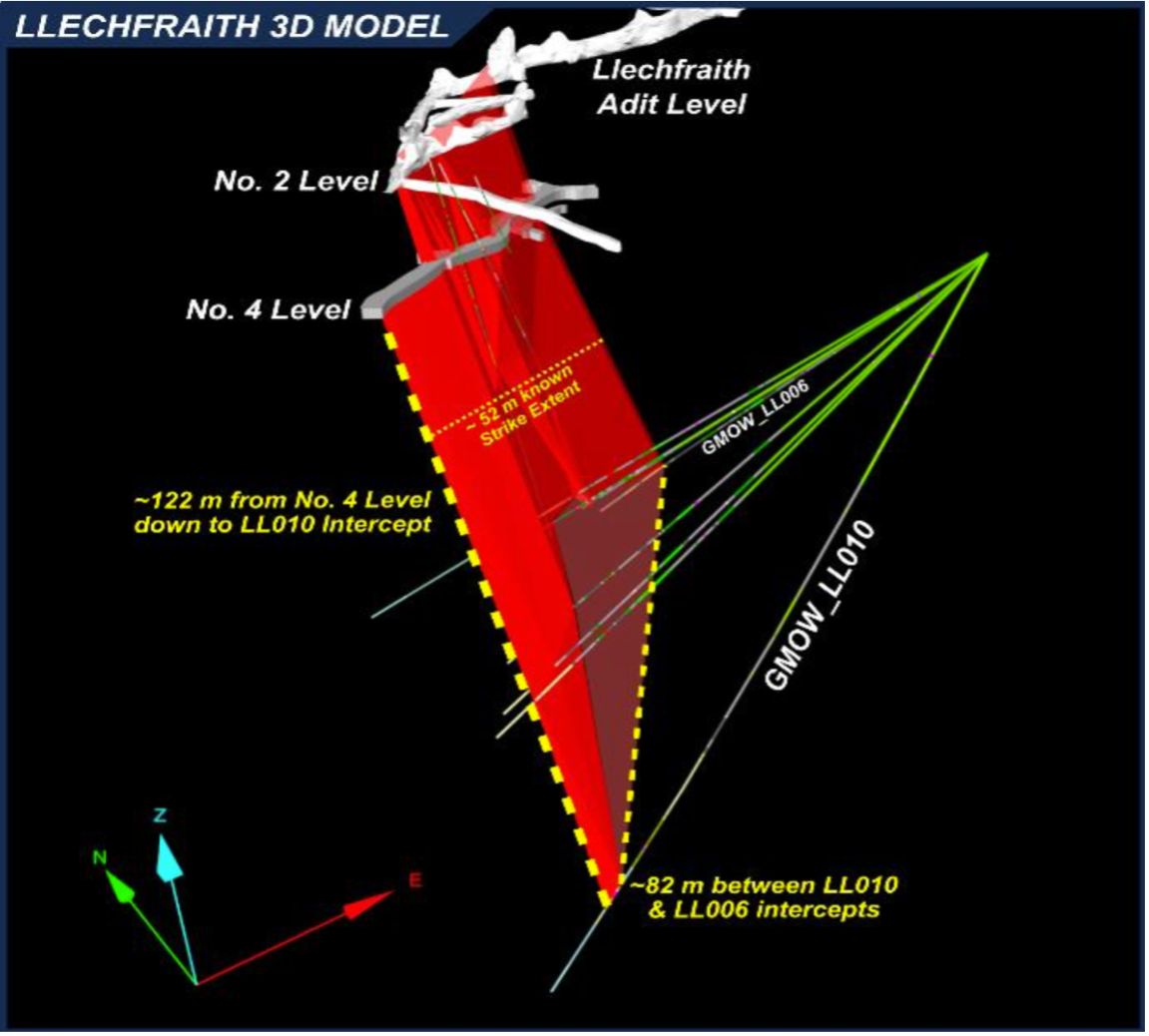
In the event, the hole has greatly exceeded our expectations, intersecting the lower lode at a depth of 122 metres (Fig.1) below the lowest workings,” said COO of Alba, Mark Austin.
Figure 1: 3D projected view of current Llechfraith 3D geological model, integrating both surface drilling programmes completed by Alba to date. Lower Lode intercept in LL010 intersects 122 m below No. 4 Level, and 82 m from easternmost intercept in LL006.
 (Source: Alba Mineral Resources)
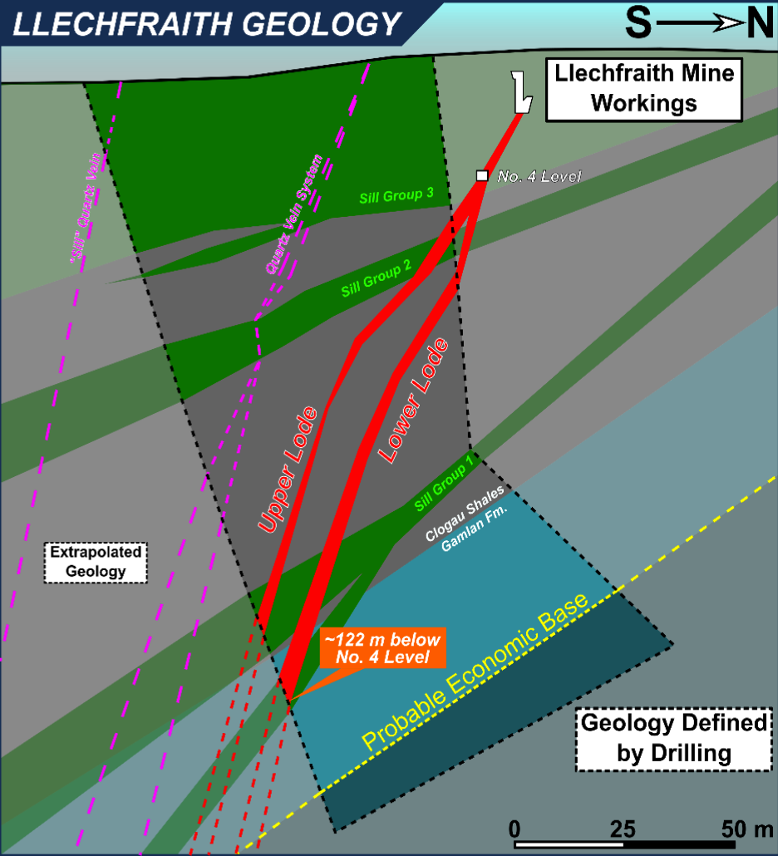
LL010, which is the deepest hole to be drilled at 176.4m, intersected the Upper Lode quartz vein system from 120 to 129 m and the Lower Lode quartz vein system from 139 to 145 m.
A total of 1.82 m of quartz veins were intersected in the Upper Lode and 5.92 m in the Lower Lode including one intercept of 3.73m which is the widest intercept in the entire programme.
At its deepest point LL010 intersected the lode structure 122 m (Fig.2) below the existing Llechfraith mine workings, almost doubling the depth extent identified previously by LL009 (at 66 m.)
Figure 2: Simplified Geological Cross Section of the Llechfraith Lode system.
(Source: Alba Mineral Resources)
The lode structure remains open at depth in economic stratigraphy below LL010’s deepest intercept, and the western strike extent has yet to be constrained, meaning the tonnage estimation for the Lower Lode could be materially increased with further exploration drilling.
It said intersecting the lode structure at such depth has ‘significant implications for the entire Clogau St. David’s Project, as it indicates that gold-bearing structures mined in and around the mine could extend significantly to depths which historical mining efforts never reached.’
Commenting on these efforts, Austin stated, “This has implications for the entire Clogau St. David’s Gold Mine, as it indicates that gold-bearing structures mined in and around the Mine could extend significantly to depths which historical mining never reached. “
He added that, “This will be further tested very soon, as we embark on Phase 2 of our surface drilling programme targeting the depth extensions of the 7-10 and Grandfathers Lodes, which were significant sites of past production on the Llechfraith Adit Level.”
“This should give a good indication of the sheer size of the Llechfraith Lode and its potential significance for our future development and production plans at Clogau,” said Austin.
Shares in Alba Mineral Resources have already seen an over three-fold increase for shareholders since August 2020. Drilling at Clogau-St David continues to surpass expectations with LL010 almost doubling the depth extent identified previously by LL009.
Alba said the success at LL010 strongly reinforces its view that the newly modelled zone, “the Llechfraith Lode”, is a key target for future development and production at the Clogau site.
As the Phase 1 surface drilling programme comes to an end, Alba now looks towards starting Phase 2 which, as previously advised, comprises an 8-10 hole project for up to 2000m.
Alba said these holes will play ‘a critical role’ in the geological model at Clogau as the team continues to identify near-mine exploration targets for future development and production.
Reasons to Follow ALBA
Alba Mineral Resources is a well-diversified mineral exploration and development company which owns and operates mining projects in Greenland, Wales and Ireland. Its strategy is to identify and secure undervalued assets with a diversified commodity mix where there is potential for discovering further unexploited resources alongside the existing mine site.
Limerick Base Metals Project
Historically, only eight drillholes have been completed within Alba’s Project area of the Limerick Base Metals Project, the most recent being the three holes drilled in Q2 of 2019.
Alba said these low levels of drilling are unusual in the Irish context and, for this reason, the area is considered under-explored. Alba has previously identified a number of attractive targets that have never been drilled before.
Alba’s current technical team, led by Mark Austin, Alba’s COO and Senior Geologist, will undertake a comprehensive review of the licence area before determining the next phase of planned exploration activities.
The expenditure conditions attaching to the renewal of PL 3824 require Alba to incur expenditure of €15,732 by 26 May 2021 with a further €50,000 to be spent by 26 May 2022.
JORC Resource expected at St David’s Clogau Gold Mine
Despite losing field time to the COVID-19 pandemic, Alba said it is in a position to execute one of the most significant underground work programmes seen for several decades at its Clogau gold mine in Wales, just as the commodity is reaching all-time highs in value.
Alba said its mining projects remain on ‘a sound footing’, with JORC resources at both Thule Black Sands and Melville Bay, and plans to drill a maiden JORC resource at Amitsoq in 2021.
Amitsoq
In recent weeks, Alba said an independent testwork programme at the Group’s Amitsoq graphite project in southern Greenland has confirmed ‘very high carbon content.’
Due to the high carbon content, the product would offer ‘a significant advantage, as no purification would be needed to achieve that level,’ the Company explained to investors.
Accordingly, subject to certain follow-up testwork which the Group said is recommended, the testwork successfully indicates the suitability of Amitsoq graphite as feed material for Lithium-Ion Batteries ("LIBs"), the fastest growing market for flake graphite globally.
‘This finding that the concentrate appears to be suitable for LIBs is significant, as the market for LIBs is the fastest growing market for flake graphite, with massive growth rates forecast for the next decade due to the expected demand for LIBs in electric vehicles,’ Alba outlined.
Transition from Exploration to Production in Greenland and Wales
Other ‘significant’ progress has also been made in recent years towards Alba’s ultimate goal of achieving commercial production at one or more of its sites, including at the Thule Black Sands in Greenland, the Amitsoq project in Greenland and the Horse Hill well in Surrey.
In 2020, Alba has announced that surface trenching activities would kick-start over the first of the group’s 10 regional gold targets over the Dolgellau Gold Field.
The trenching will target the first of 10 separate new gold targets over the Dolgellau Gold Field which have previously been identified by Alba.
Alba said up to eight trenches have been planned in this first phase, each varying in length from 40-90m for a total of 575m, with each trench being 1m wide and up to 2m deep.
Once exposed, the quartz veining and other structures from the trenches, those of which are pictured below, will be sampled, and those samples sent to a laboratory for assaying.